JIL welcomes the 2026 Justice Innovation Accelerator Cohort
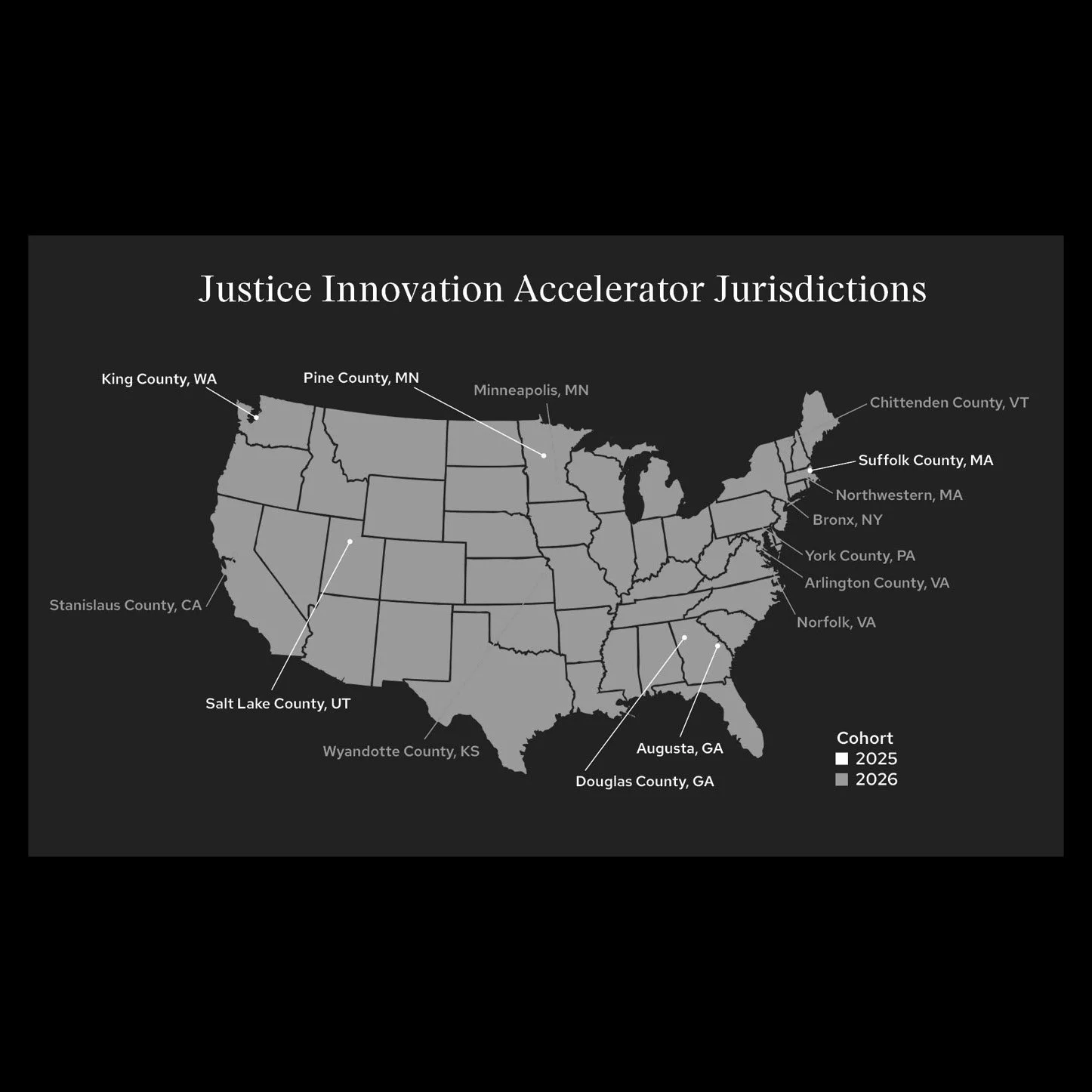
After a competitive selection process, we're excited to announce the nine communities joining this year's Justice Innovation Accelerator cohort:
Arlington, VA
Bronx County, NY
Chittenden County, VT
Minneapolis, MN
Norfolk, VA
Northwestern District, MA
Stanislaus County, CA
Wyandotte County, KS
York County, PA
The leaders from these communities understand something important: the problems in their justice systems won't solve themselves. Fixing them requires hard, creative work and a genuine willingness to build something better. They have signed up for exactly that.
What happens next
Over the next six months, each team will identify the specific problem it wants to tackle and assemble the people with the authority and expertise to solve it. In October, all nine teams will convene at Vanderbilt Law School for an intensive, in-person workshop. The Accelerator is co-hosted with the Vanderbilt Project on Prosecution Policy.
They'll arrive with real challenges. They'll leave Nashville with concrete, actionable plans to take home and pilot. Through design thinking, systems mapping, and hands-on collaboration, they won't just be theorizing about change, they'll be building it.
What this looks like in practice
Last year's cohort is the best answer to the question of what the Accelerator actually produces.
They arrived with bold ideas. They left with real plans. And they've been building ever since.
The Suffolk County DA's Office (Boston, MA) is building SWIFT Justice — a cross-agency diversion program that connects people with substance use challenges to recovery coaches and treatment, using real-time data sharing to improve access to housing, employment, and care.
The Salt Lake County DA's Office (UT) is scaling a pre-file diversion program with a 93% success rate and less than 4% recidivism, expanding referrals, training, and data tracking to reach more people.
The Pine County Attorney's Office (MN) is improving victim services through a single point of contact, enhanced lethality assessments, and digital outreach tools.
These aren't ideas on a whiteboard. They're real solutions being implemented right now.
Congratulations to our incoming 2026 cohort. We can't wait to see what you design.